Vision-led. Strategy-backed. Built to move a room before it moves a roadmap.
Role | Product Designer & Design Strategist |
Focus | Engage × Teams integration — vision, strategy, and an agentic AI concept |
Team | 5-person strategy crew (2 PM, 1 Design, 1 UXR, 1 DS) |
Timeline | Aug 2025 – Nov 2025 |
This started as a vague brief — "grow leaders on Engage" — and became a pitch for an AI Leadership Agent at Engage's internal idea fest.

This is vision work: its job was to set direction before a single line of production code got written. What it did was reframe who the product should serve, and give the team a vision concrete enough to design, prototype, and defend in a room. This is that story.
The problem
Engage is Microsoft's org-wide social layer (like your company Facebook), and leaders are its highest-value posters — a single leadership announcement reached ~70% of its audience in a week, versus ~28% for an ordinary post. But leader-audience growth had been flat at ~29% share for months, and participation in the dedicated Leadership Corner sat below 5%. The upside was obvious. The product wasn't delivering it, and "grow leaders" as a brief didn't say how.
I started with a reality check: a leadership tear-down and an Engage walkthrough to see the experience as leaders actually lived it.

From there I led a cross-feature workshop (LEGIT) to align design, PM, and engineering on a vision for "storyline + leadership," then ran a gap-to-opportunity workshop with feature crew leads to turn what we'd heard into a prioritized set of goals.
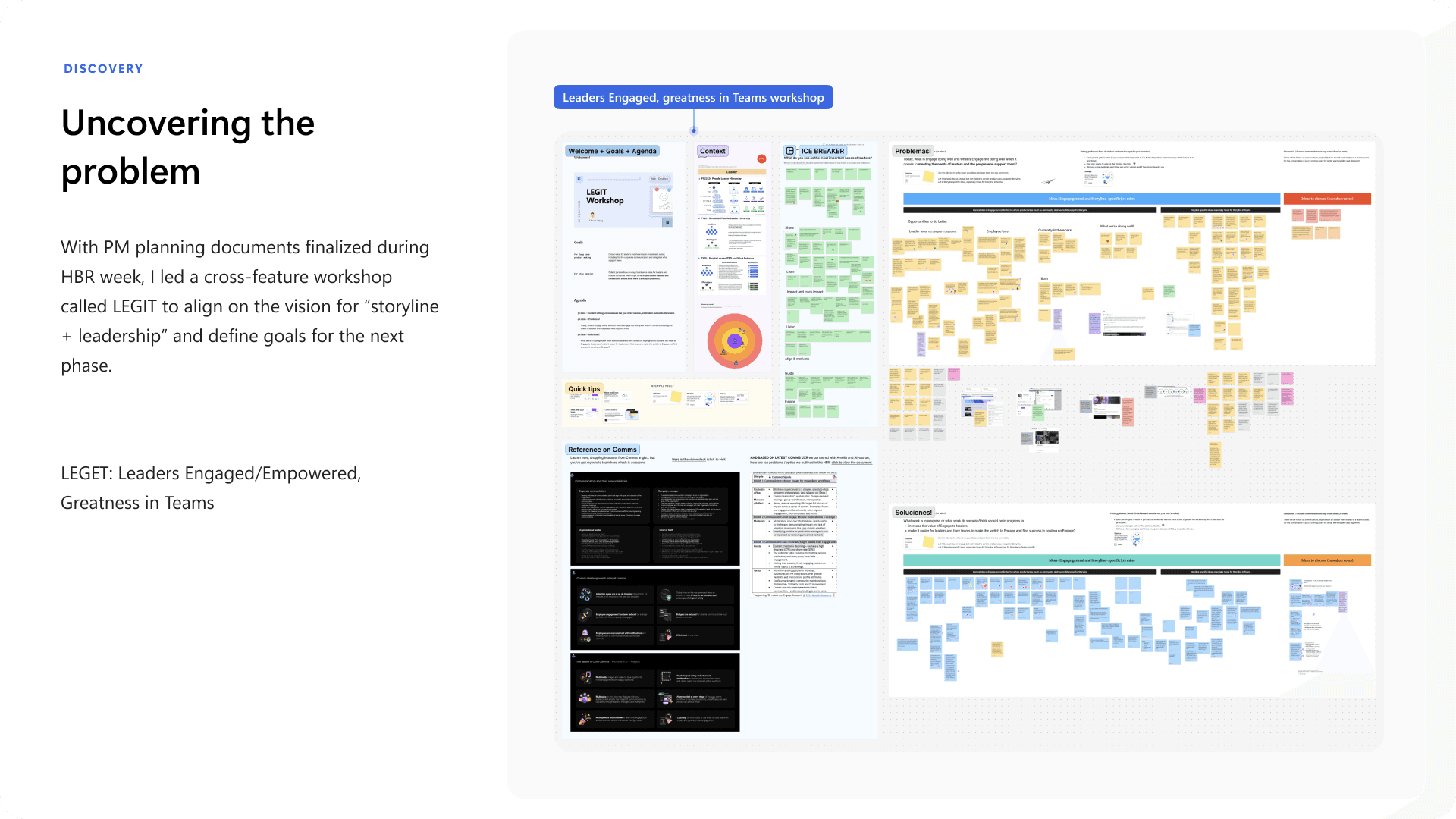
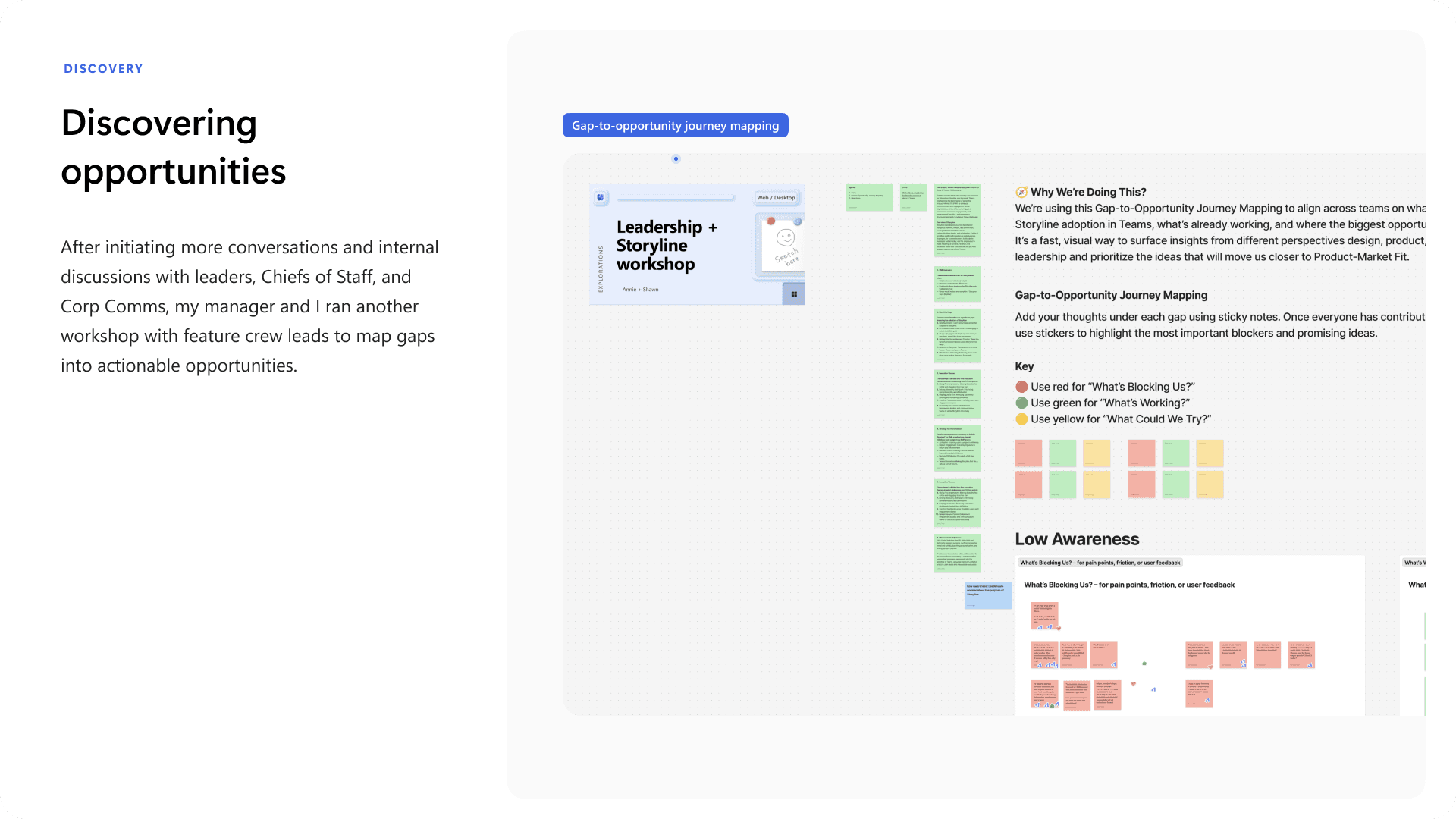
That process is what turned a vague ask into a real product problem: leadership on Engage hadn't found product–market fit, and low adoption traced back to specific, unaddressed pain points in how leaders actually communicate — not a lack of leader interest.
The bet — who we build for
Leadership on Engage is really four distinct audiences — People Leaders, Strategic Leaders, Senior/Executive Leaders, and Emerging Leaders — and the default focus had been the top of that list: get more executives posting. It made intuitive sense, but the data said otherwise. Growth had stalled for months, and the executive population is small and already served by dedicated comms teams — pushing harder there wasn't going to move the product. Leadership on Engage hadn't reached product–market fit, and the team, led by my PM, made the call to stop optimizing for the C-suite and go after the layer with real influence but no support system: Strategic and Emerging leaders.
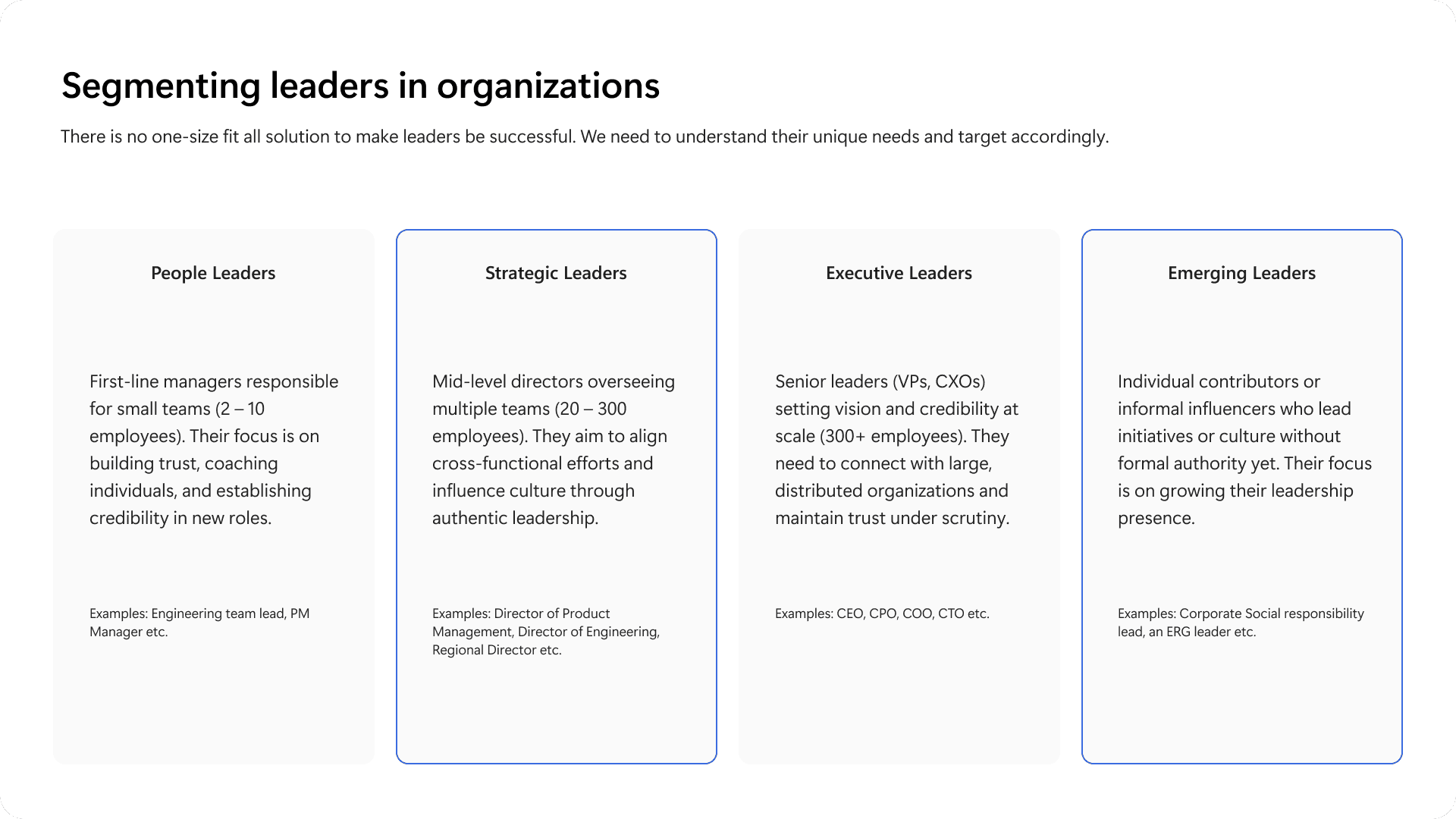
The proof point that made the case concrete: of ~99.3K people with 20–300 direct reports, only 0.83% (820) had an assigned audience on Engage. Huge, underserved, and reachable — and specific enough that design could stop debating who we were building for and start building.
Design's highest-leverage move here wasn't a screen — it was arguing for who we build for, and backing that argument with data.
The vision — a Leadership Agent
Research surfaced three signals of effective leader communication: credibility, authenticity, and connection.
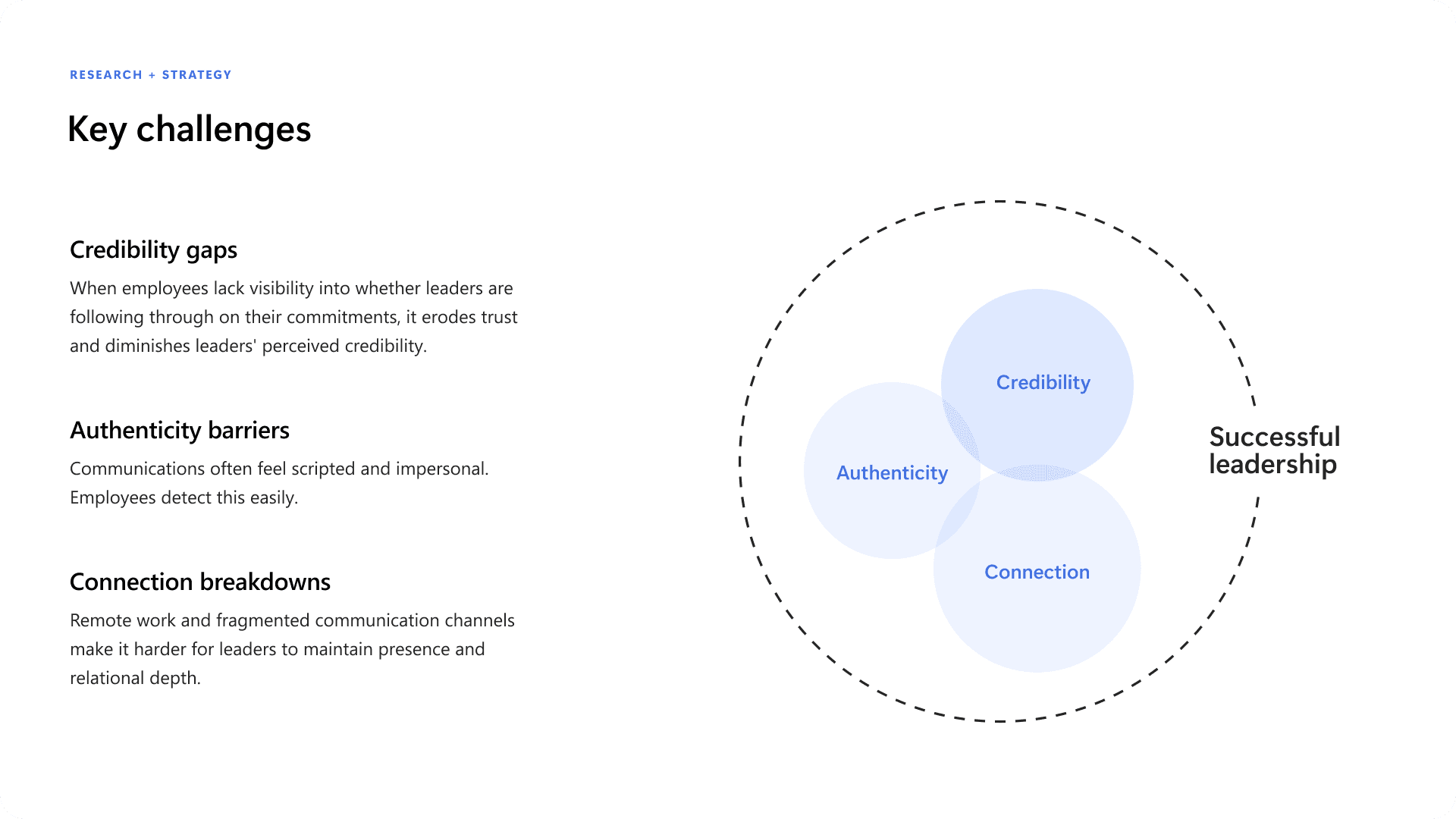
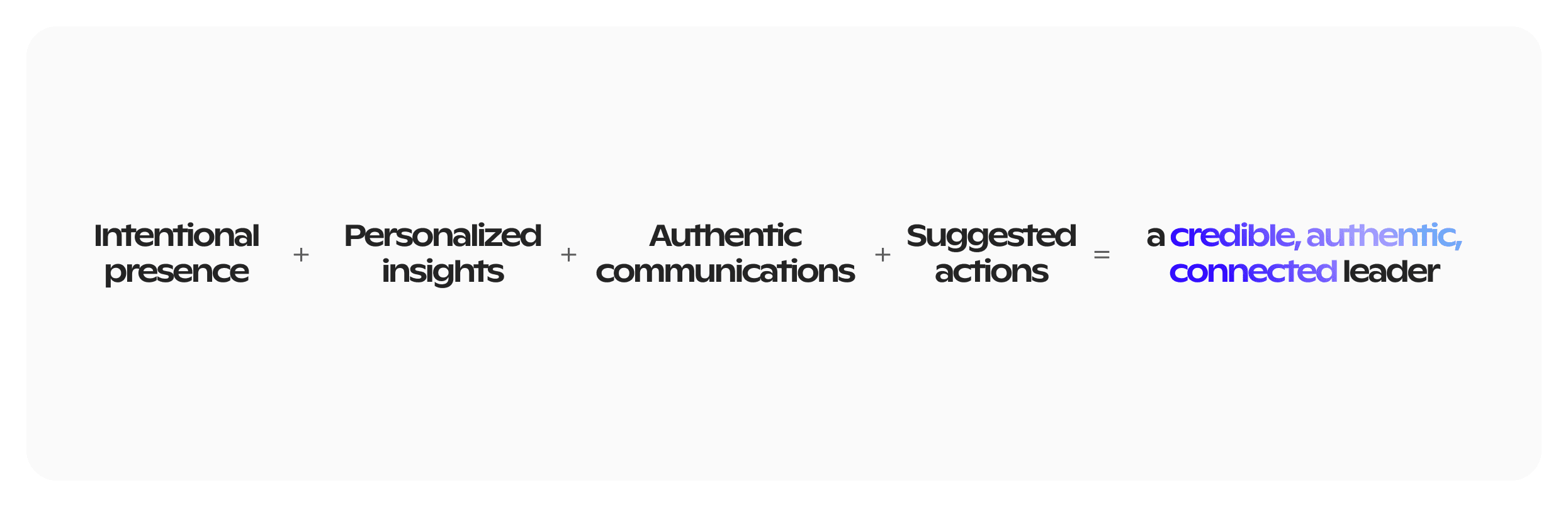
From those three signals, we shaped a single product idea — an AI Leadership Agent that helps a leader be present, understand their people, communicate in their own voice, and act. One formula, simple enough for the whole team to design against:
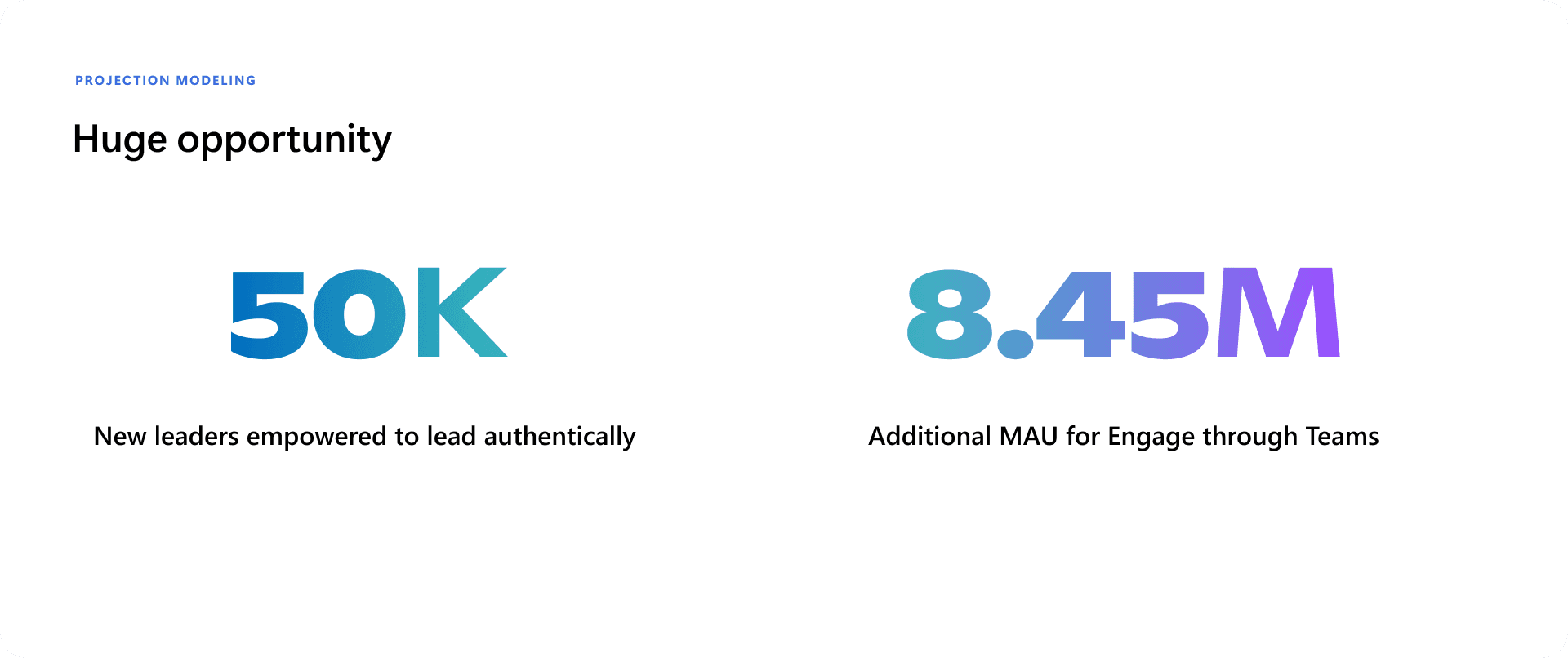
That number also anchors the growth case: getting 50K new leaders set up with assigned audiences and active on storyline was modeled to unlock 8.45M additional MAU for Engage — reach made possible by putting leadership storyline natively inside Teams, where those leaders' audiences already live. It wasn't a forecast; it was the number that made the vision worth building for.
The design — native, and felt
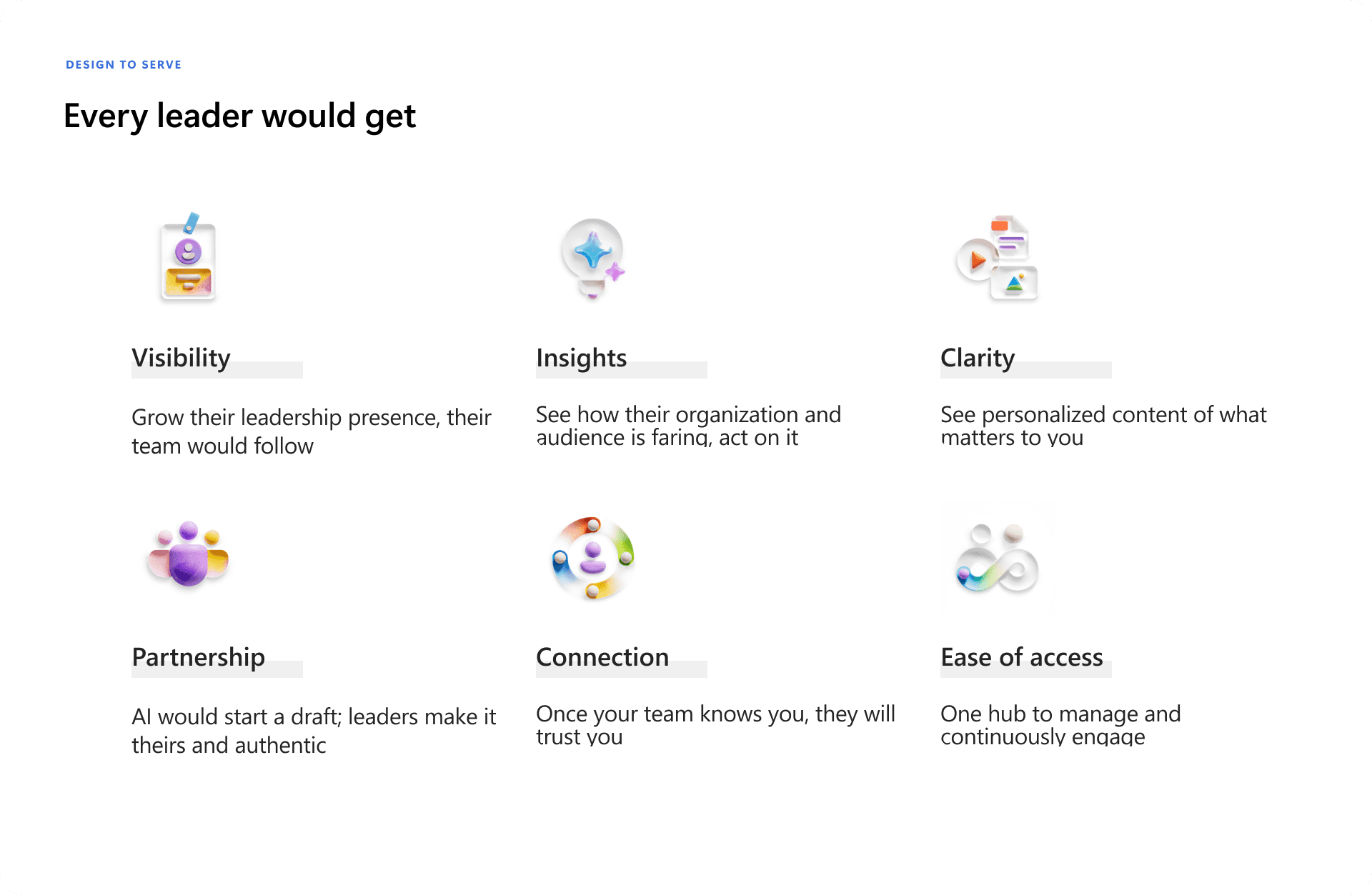
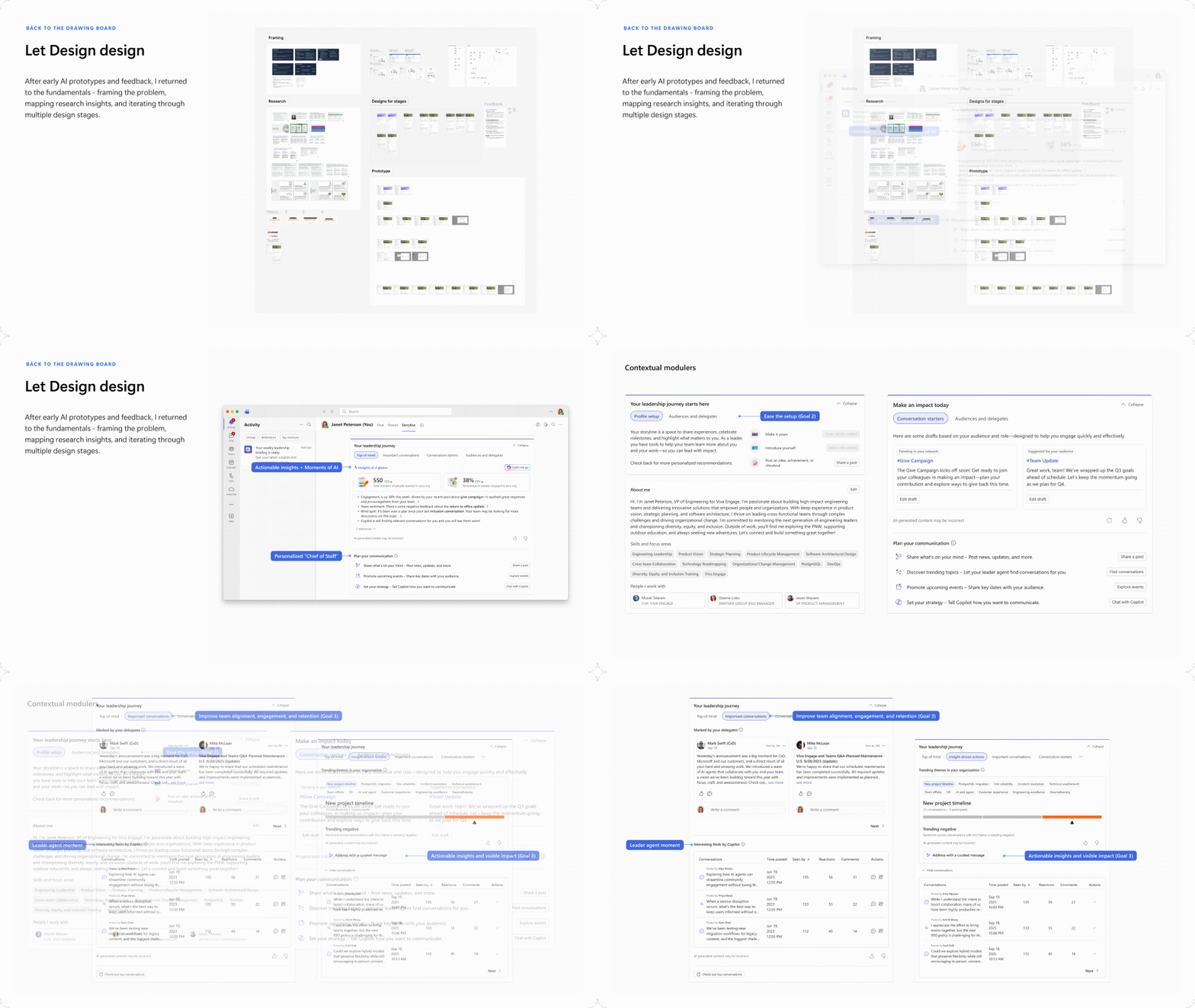
I designed the experience to live natively inside Teams storyline, as contextual modules each tied to one job: intentional presence, effortless setup, insight you can act on.
Numbers and a formula convince a room intellectually, but they don't make people feel the future — so I designed and produced a concept demo showing a leader's first eight weeks with the agent, from an empty profile to a rising Leader Communication Index.
The pitch — and how it landed
Wole and I co-created the pitch together; Wole presented it at Engage's internal idea fest.
Scroll to the bottom of this page to watch it without leaving this site, or click to watch the pitch demo video on YouTube.
It landed well — the strategic-leader focus and the AI tooling were both called out specifically — and the toughest questions from the room went straight at the parts of the strategy with the most riding on them: data sources, segmentation, and how "suggested actions" would actually get generated.
Theme | What it means |
|---|---|
Leadership & Communication | Add 50,000 net new leaders with assigned audiences and help them be successful communicators. |
Agents that scale | Introduce a new Engage agent to drive the utility of AI agents — make communication 10× easier, better & faster. |
Native Teams Integration | Reach an additional 8.5M users in Teams, and increase the likelihood of leaders adopting Teams as their leadership tool. |
Copilot Success | Humanize Copilot for leaders as an assistant, evaluator, and coach to help them be credible, authentic & connected. |
That's the outcome I wanted: if a room pushes on your riskiest bets instead of your polish, it means they took the bet seriously.
Reflections
Strategy is design’s job too The highest-leverage decision here wasn't a screen — it was the discovery work I ran (the tear-down, the workshops) that turned "grow leaders" from a hunch into a data-backed case for who we should actually build for. Design that starts at the problem, not the layout, is where I do my best work.
Partnership beats ownership This vision belongs to Wole and me together. The skill wasn't claiming it — it was knowing what to lead (the design, the demo) and what to build side-by-side (the strategy), and letting co-authorship make it stronger than either of us alone.
A vision has to be felt, not argued Our sharpest artifact wasn't the deck — it was the eight-week demo video. It aligned the room faster than any bullet list could. If people can't feel the future you're describing, they won't back it.
A north star is a direction, not a deliverable This was built for Engage's idea fest, and its job from day one was to set direction — generate energy, stretch what the team thought was possible, and give people something concrete to react to before committing real engineering to it. That's exactly what it did: the leadership crew is still drawing on it to shape how they build credible, authentic, connected leadership going forward.

