1 product. 2 chapters. 3 years. Lasting impact.
Role | Product Designer, IC |
Focus | Campaign management, Design systems |
Team | 15-person feature crew (1 PM, 1 EM with engineers, 1 UXR, 1 Content) |
Timeline | Jan 2022 – Jan 2025 (represented in two chapters) |
Impact at a glance
The context
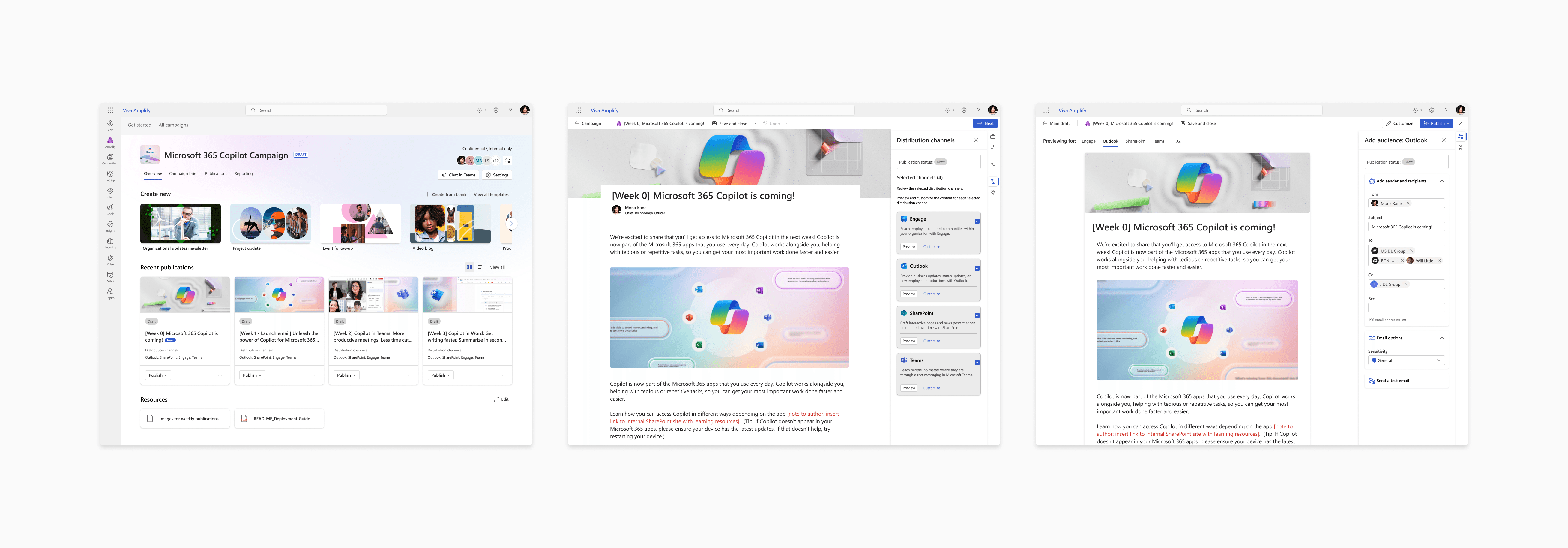
Corporate comms teams had no unified tool for planning, publishing, and measuring employee communications across Microsoft 365. Amplify was built to fix that. I joined before a single feature shipped and spent three years designing its core - campaign management and everything in between. It’s a story of chapters. (toggle to read)
Chapter 1 · Building the product from zero
Jan 2022 – Oct 2023 · No prior art. No template to copy. A small team with startup speed inside a large corporation — designers owned more end-to-end than is typical at Microsoft.
What I designed
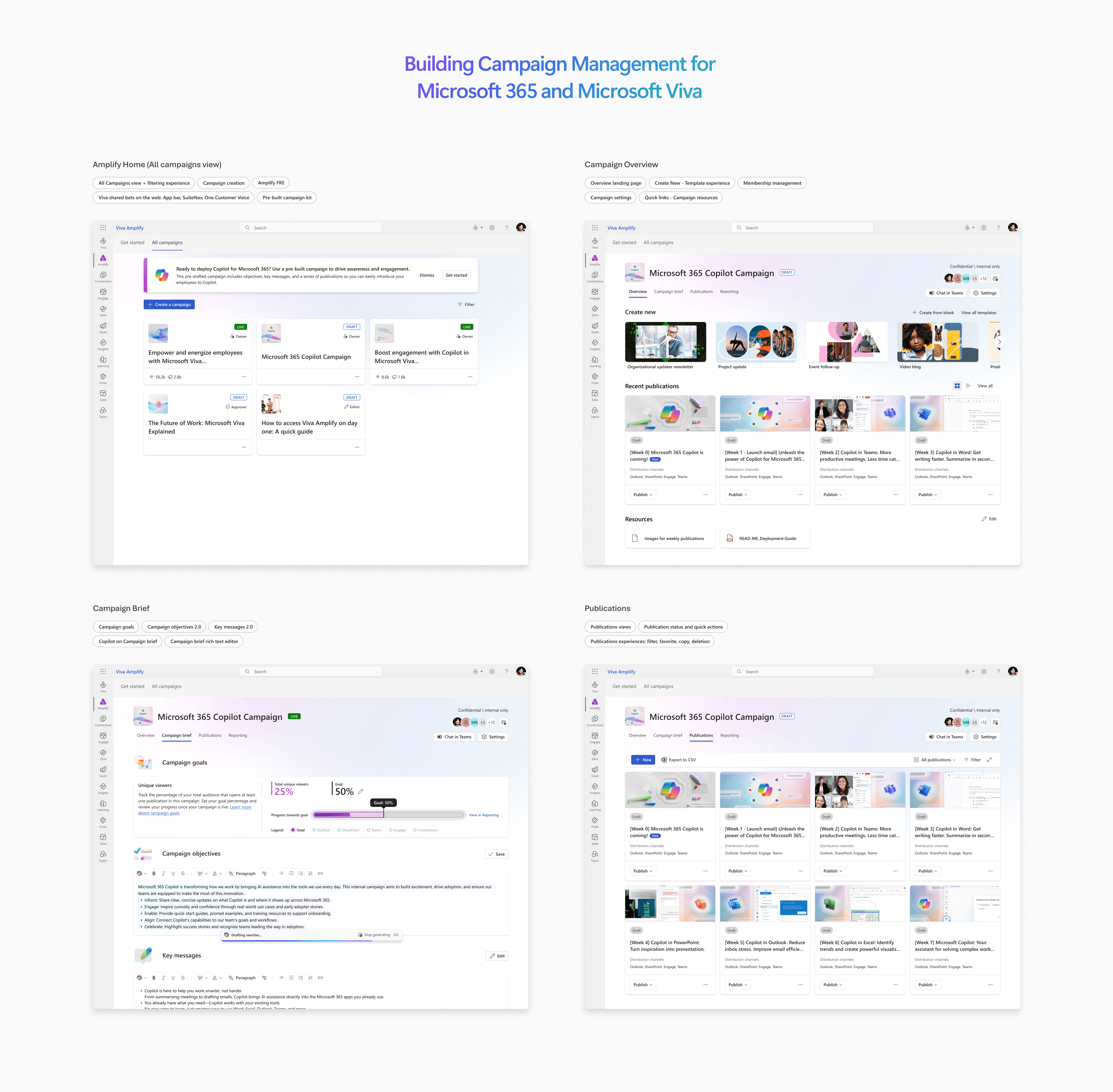
🏠 Amplify Home — The campaign dashboard — a communicator's central HQ showing all active, draft, and completed campaigns at a glance.
📋 Campaign Brief — A planning space for defining campaign objectives, key messages, and target audiences before publishing anything.
🎯 Campaign Goals — Lets communicators set measurable targets (e.g. "reach 80% of employees"), then tracks actual vs. goal in real time.
📰 Publications Management — A content library for managing every post and article within a campaign, with publishing status across all channels.
Campaign Brief: inheriting a problem, owning the fix
When the designer who owned Campaign Brief left, I took over and pressure-tested the direction. The original vision — a structured form with fixed fields — looked organized but was solving for our assumptions, not reality. I brought a freeform concept to an internal MVP summit, it got traction, and I followed up with a research study of 6 recruits to validate it. The data was clear: communicators return to the brief throughout a campaign, refine their thinking, use it as a living reference. A rigid form couldn't support that. I pushed the redesign through reviews, got alignment, and shipped a rich text editor paired with a goal tracker.
The work compounded beyond the feature. I partnered with the Viva Personality team on a confetti animation for goal completion — later adopted by other Viva products unprompted, which at Microsoft is the signal it identified something real. I connected the brief to Reporting end-to-end with a senior designer — goals set in my space, actuals tracked in his. And when a pre-built campaigns initiative launched, I pushed it forward with the growth PM — a meaningful share of those 2,290+ campaigns created came directly from those kits.
The design systems arc — the thread that runs through both
One continuous responsibility. Two completely different problems.
Chapter 1 · Establishing identity — Whose product is Amplify?
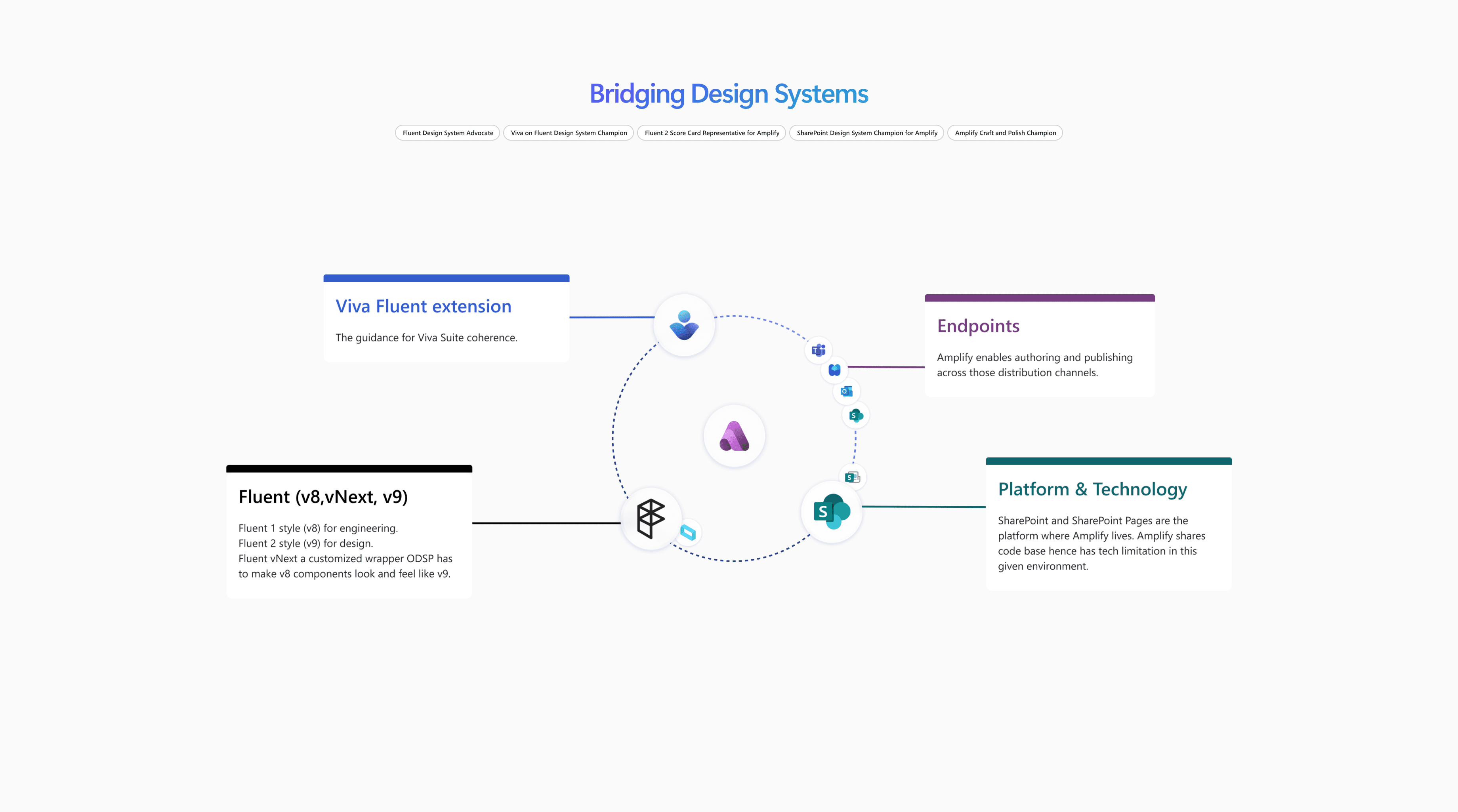
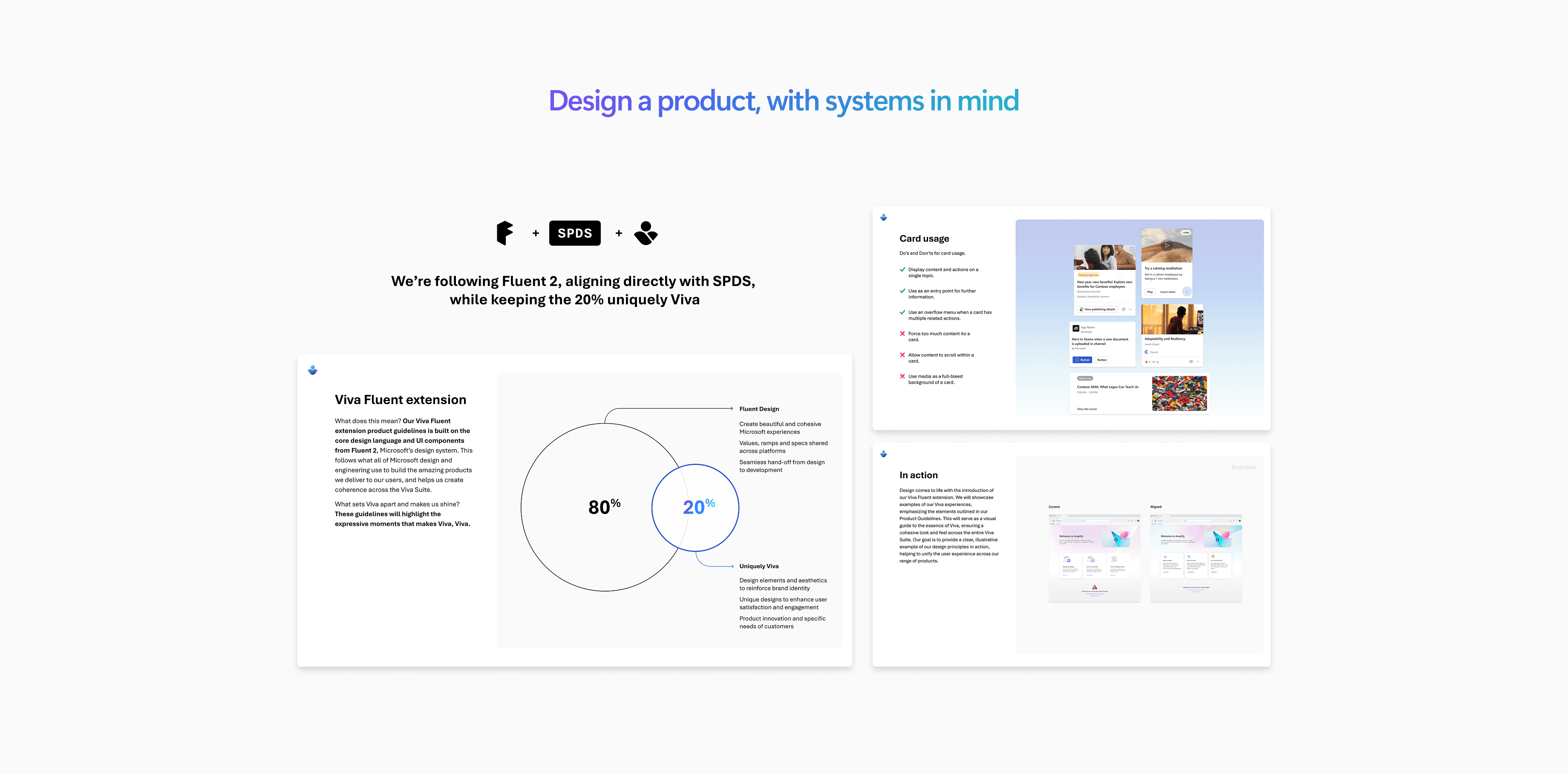
Amplify lived in Viva, ran on SharePoint infrastructure, published to Teams and Outlook. No single platform claimed it. I contributed to the Viva-wide 80-20 framework: 80% Fluent foundations, 20% distinctly Viva. Partnered with UXE on coherence documentation, a component monitoring dashboard, and a co-led Fluent v9 migration — giving the product a premium, consistent identity before GA.
Chapter 2 · Enforcing alignment — Now follow SharePoint's lead
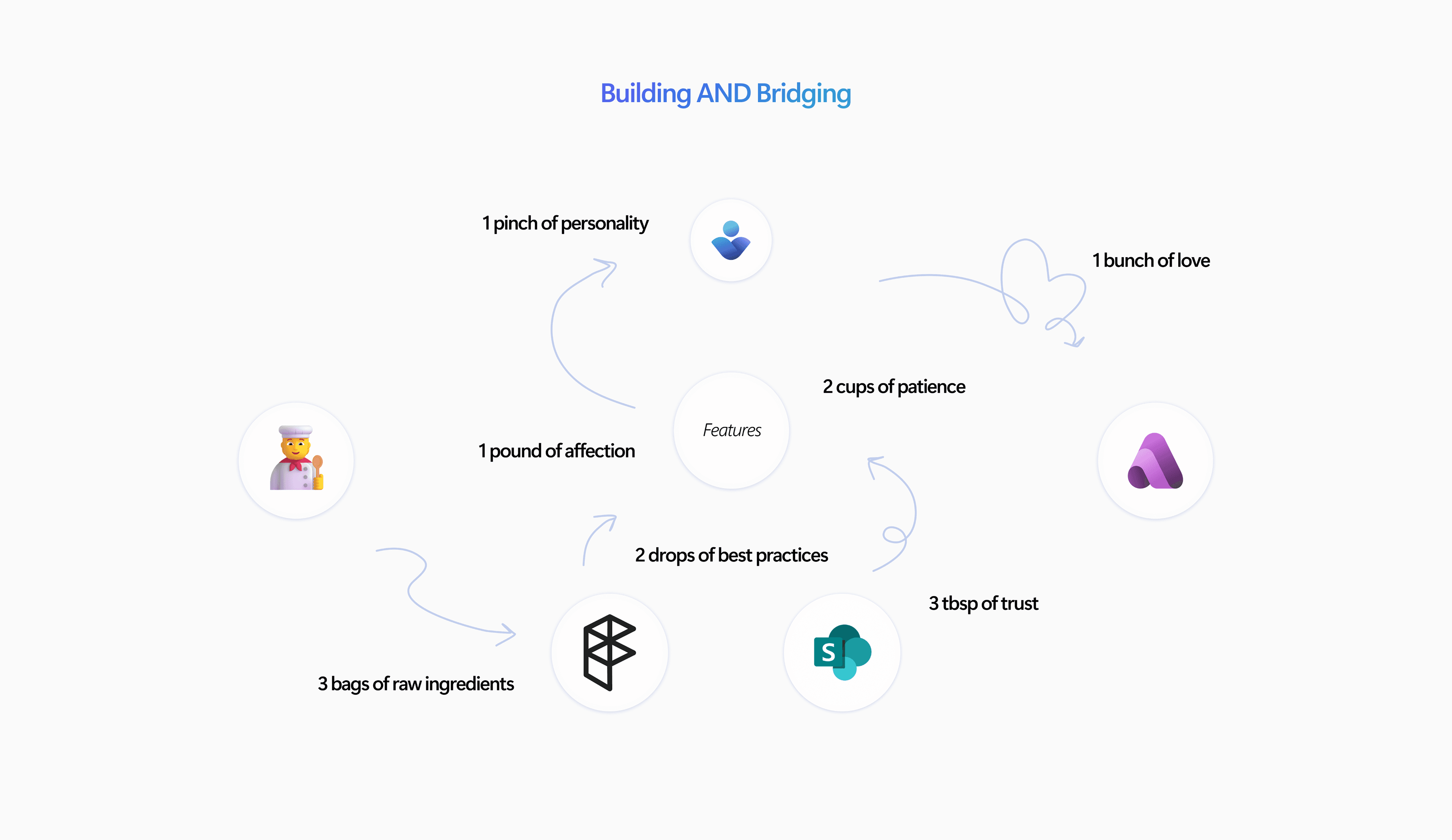
When Amplify moves inside SharePoint, asserting its identity becomes the wrong instinct — SharePoint's patterns take full priority. I audited component deviations, enforced SPDS alignment across dialogs and controls, and introduced Viva brand color tokens to replace SharePoint semantic slots — so Amplify stayed visually coherent without breaking SharePoint's theming system.
Sometimes the hardest design call isn't what to build — it's knowing which rules to follow and which ones you're allowed to break.
Chapter 2 · The strategic pivot — Amplify from Anywhere
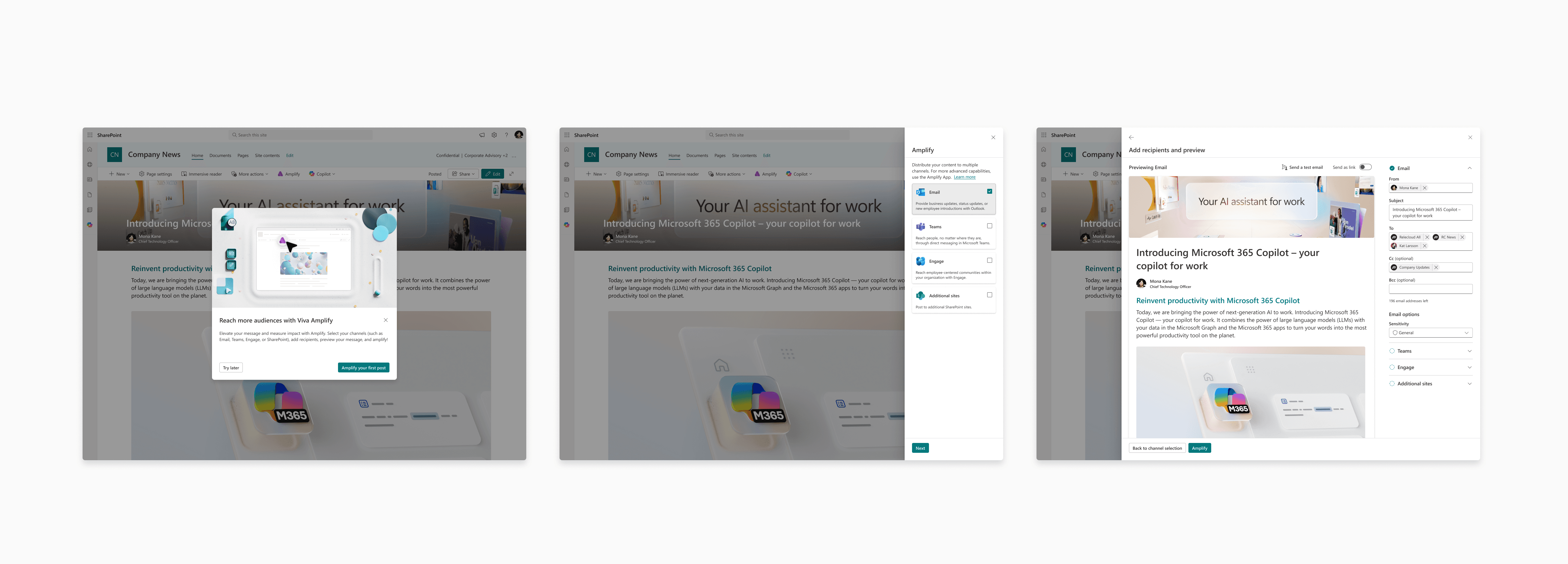
Mid-2024 – Jan 2025 · After shipping a successful product, the bigger question emerged: what if Amplify didn't need users to come to it? What if it went to them instead?
Seeing the ceiling — and being handed the hardest design problem
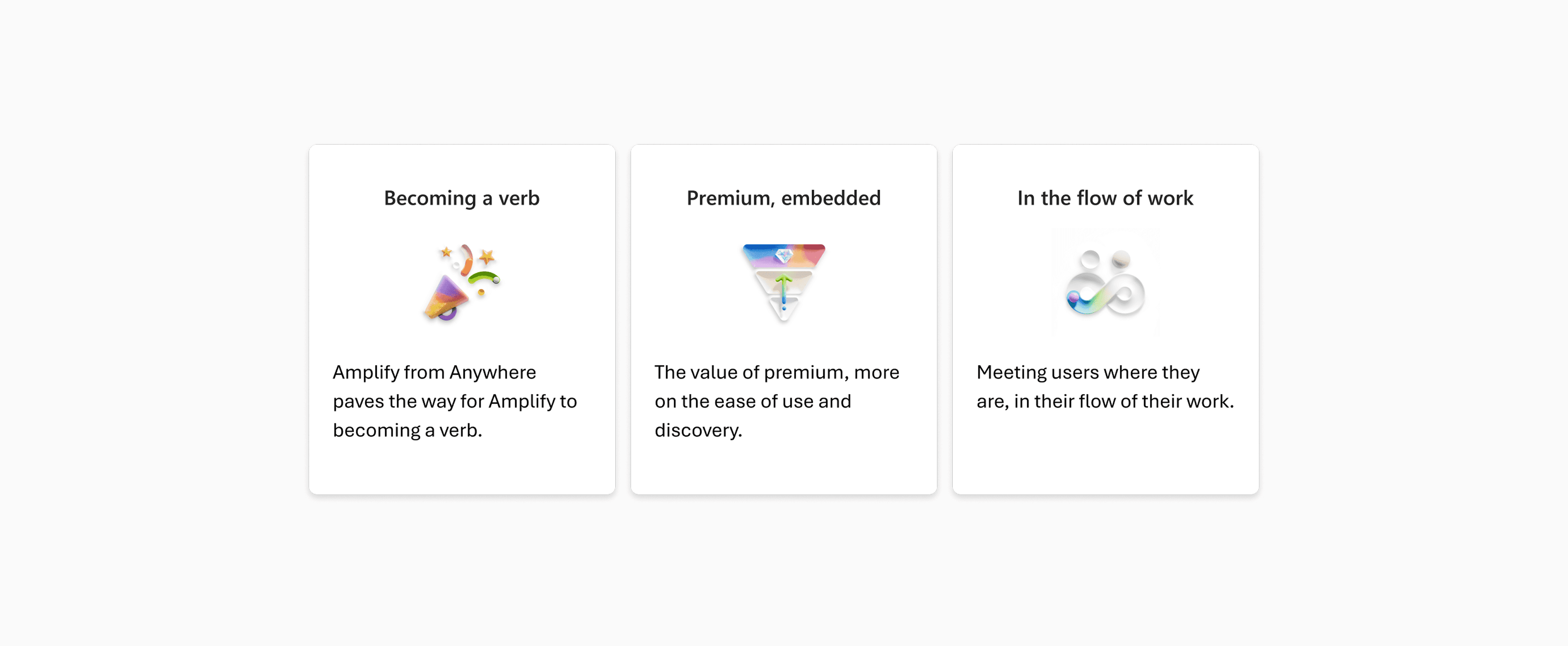
After GA, the data showed a structural limit: Amplify required deliberate onboarding. The strategic direction — "Amplify from Anywhere," moving from destination to embedded infrastructure — was set at the org level. I was brought in to execute it. That's worth being direct about, because the execution itself was the hard part.
Two design philosophies, one experience
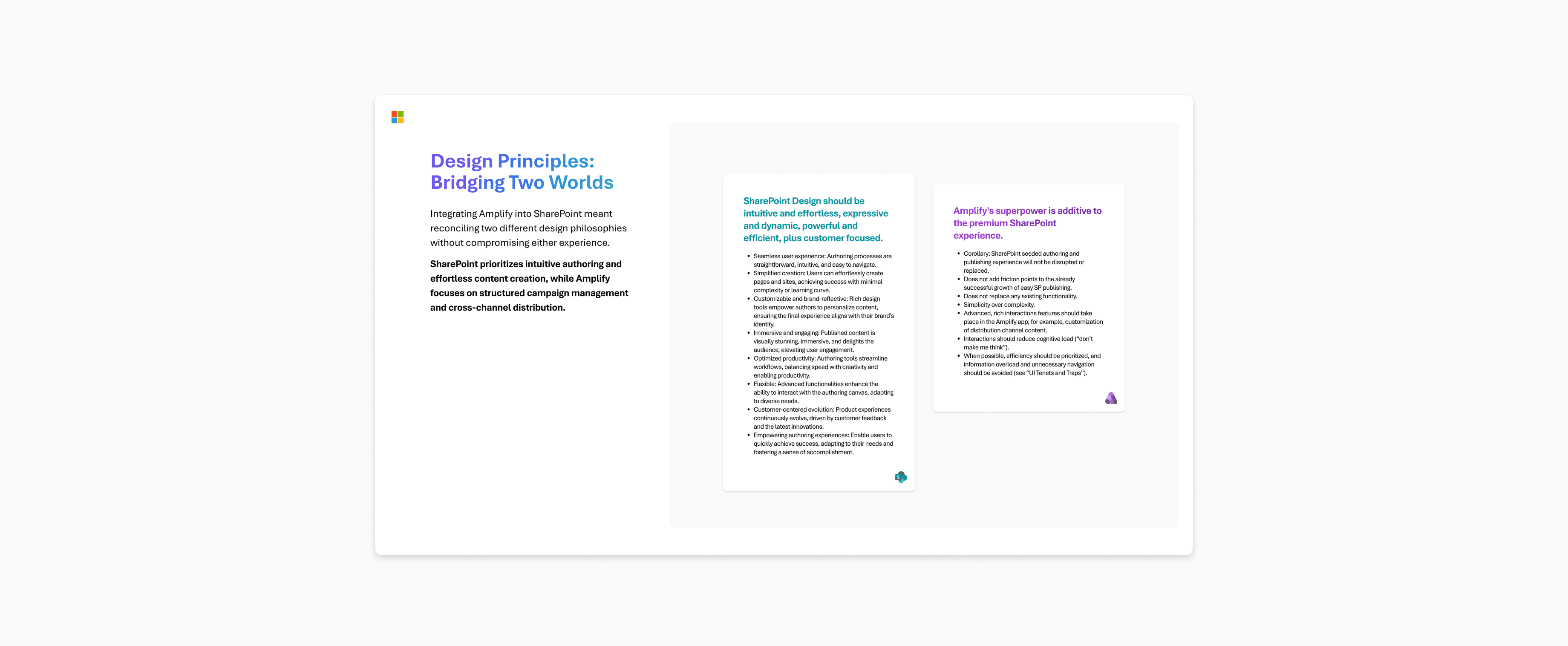
SharePoint is expressive and author-centric. Amplify is structured and governance-forward. Merging them meant real tradeoffs — Amplify's workflows couldn't disrupt SharePoint's authoring flow, but stripping it down would erase the campaign management value worth embedding.
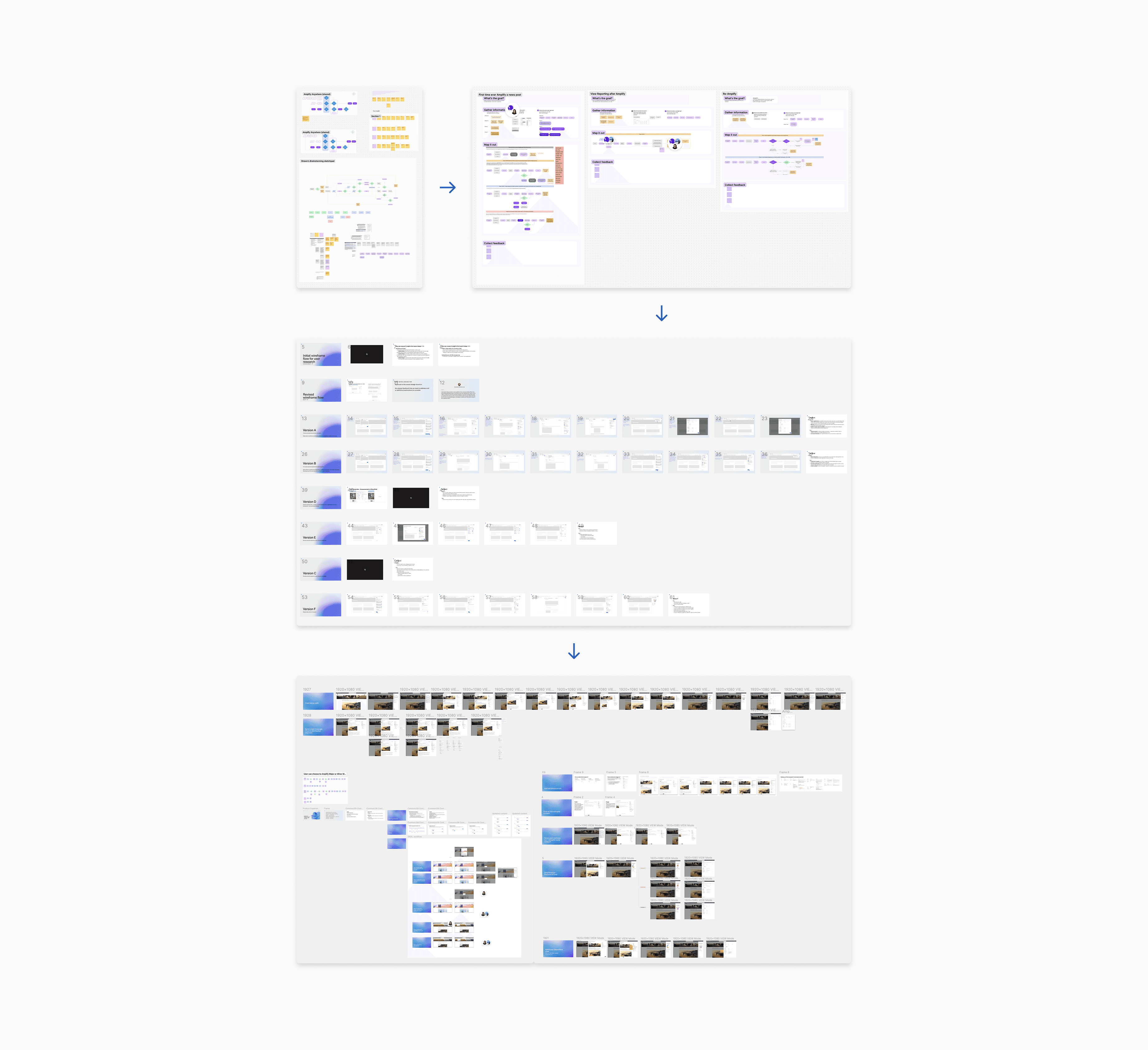
I owned the first-run experience, the core publishing UI, and the error-state design for the embedded flow — the craft layer that had to feel native inside SharePoint. Together with the other two designers, we explored 6 parallel design directions and 14 wireframe iterations before reaching hi-fi, with SharePoint design leadership across every review. Research with SharePoint authors shaped every decision: start where users already work, match familiar patterns, show the end result before publish.
Reflections
Ownership starts with questioning what you inherit I didn't redesign Campaign Brief because someone asked. I inherited the area, had reservations, and went looking for evidence. Treating "is this working?" as part of the job — not someone else's — is what made the outcome possible.
Know when to assert your voice — and when to completely let it go Chapter 1 required establishing Amplify's identity. Chapter 2 required full deference to SharePoint. Same designer, opposite instincts, both right for their moment.
Systems work is how quality compounds The coherence docs, the Fluent migration, the color tokens — none of it shows in a screenshot. But it's what makes a product feel designed rather than assembled.
Being brought in to execute is not a lesser role The strategy for Chapter 2 was set above me. But a 78% adoption rate doesn't come from strategy — it comes from execution precise enough that the friction disappears entirely.

